
Beginner guide
How to Play Wordle: Rules, Colors, and a Practice Game
Learn the rules in two minutes, then use the interactive walkthrough to see exactly what green, yellow, and gray tiles tell you—including the repeated-letter rule that trips up many new players.
Last meaningfully updated:
Wordle rules at a glance
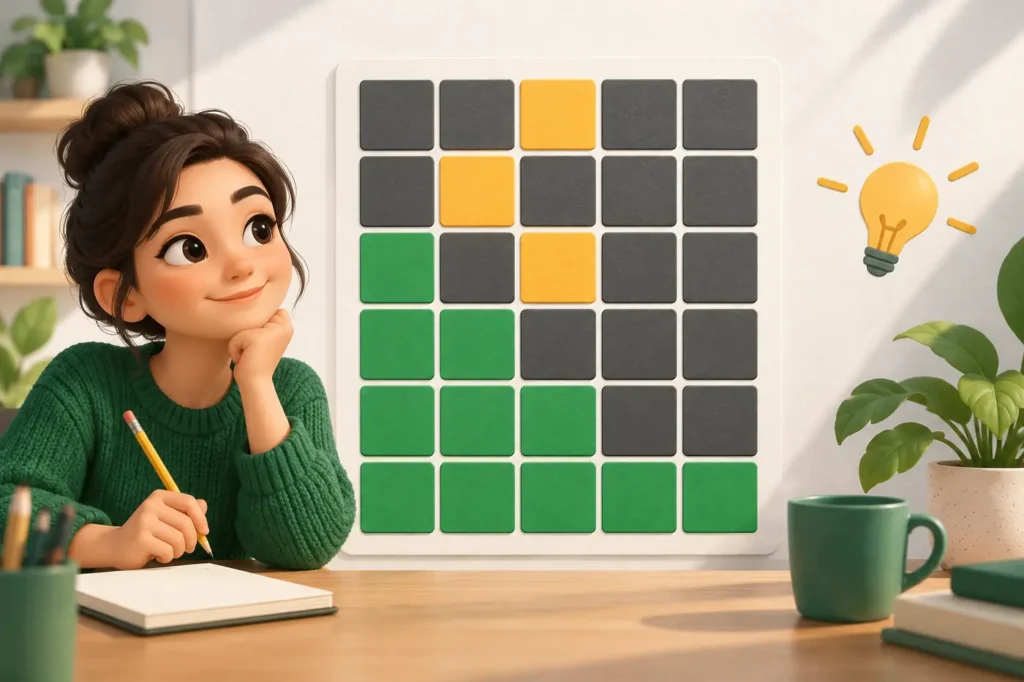
Wordle asks you to identify one hidden five-letter word in no more than six accepted guesses. Enter a real five-letter word, submit it, and use the tile colors to improve the next row. Everyone receives a daily puzzle on the official New York Times game.
- Choose an informative first word. A familiar word with five different letters gives you broader evidence than a word with duplicates.
- Read every tile. Green fixes a letter and position; yellow confirms a letter but rejects that position; gray usually removes a letter.
- Build the next guess from the evidence. Keep greens, move yellows, and test useful untried letters.
- Solve within six rows. There is no timer, so pause and check that a guess obeys all known clues.
Try an interactive practice round
This spoiler-free example uses a made-up practice solution. Move through the rows and notice how each guess has a job.
What green, yellow, and gray tiles mean
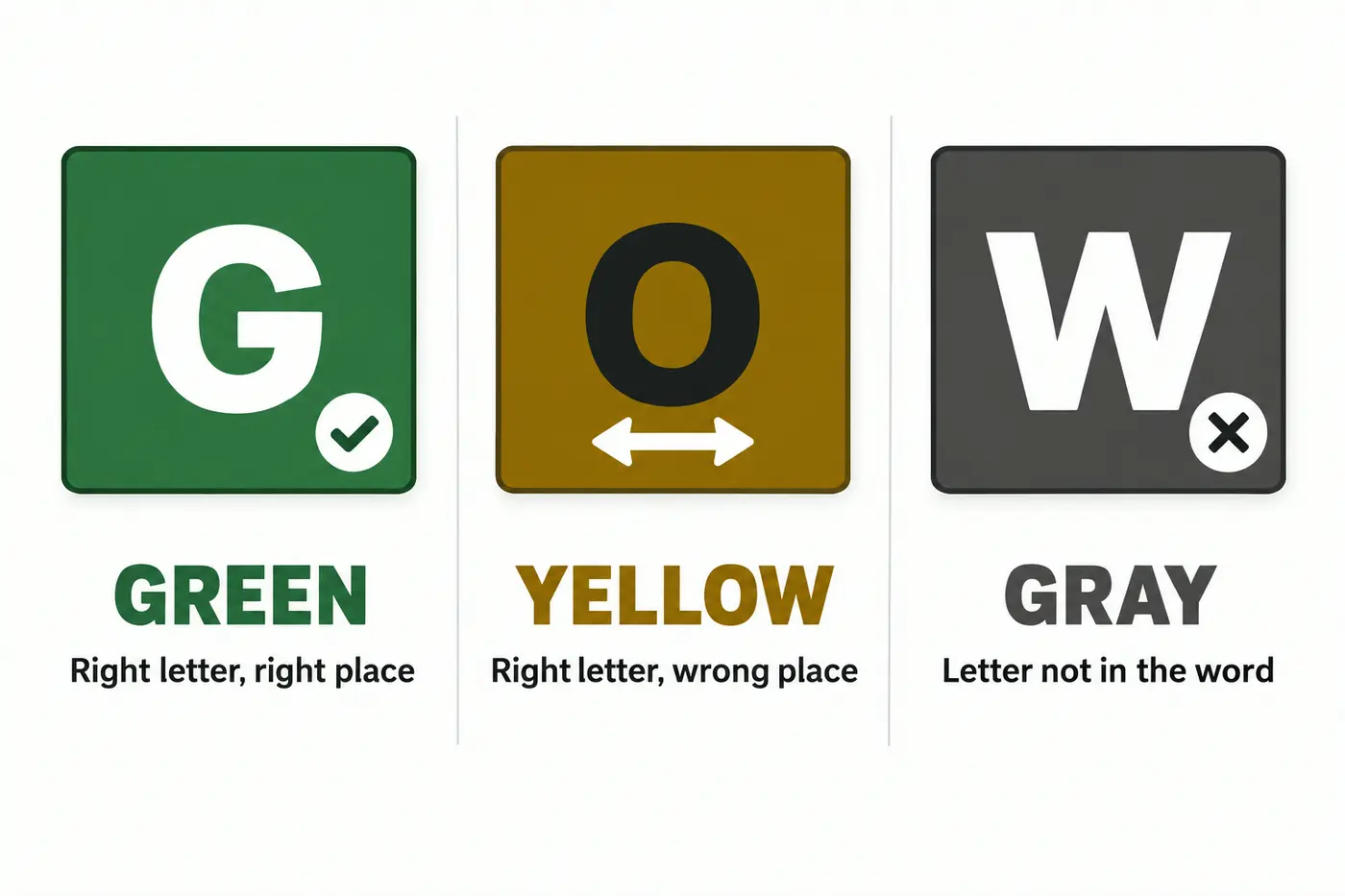
Green: correct letter, correct position
Lock it into the same square in later guesses. A green third tile means that exact letter belongs in position three.
Yellow: correct letter, wrong position
The answer contains the letter, but not in the square you tried. Move it to a position it has not already failed in.
Gray: usually not in the word
Do not reuse it unless your guess contained two copies and another copy received color. Duplicate feedback is counted against the number of copies in the answer.
Color-blind mode changes the palette, not the logic. Treat the “correct,” “present,” and “absent” states exactly the same way.
How repeated letters work
Wordle can use the same letter more than once. The board never announces a duplicate directly; it colors each copy according to how many instances exist in the answer.
Example: your guess contains two E’s
If the answer contains one E, only one of your E tiles can be green or yellow; the extra E becomes gray. That gray tile means “no additional E,” not “E is absent.” If both E tiles receive color, the answer contains at least two E’s.
This is why a gray tile should be interpreted in context. Count colored copies of the same letter before excluding it.
What Hard Mode changes
Hard Mode requires you to reuse revealed hints. Green letters must remain fixed, and confirmed letters must appear in future guesses. It prevents some exploratory guesses that deliberately ignore known letters to test a larger set of alternatives.
Hard Mode rewards disciplined play, but it can also trap you in a word family such as _IGHT or _OUND. In normal mode, a diagnostic word can test several possible first letters at once. In Hard Mode, you may have to test candidates one by one. Turn the setting on before entering your first guess.
Statistics, streaks, and useful settings
The official game can track games played, win percentage, current streak, maximum streak, and guess distribution. Signing in is the safest way to carry those statistics between devices. Browser-only data can disappear when cookies or site storage are cleared.
- Hard Mode: forces revealed hints into later guesses.
- High Contrast Mode: replaces the standard green/yellow palette with more distinguishable colors.
- Dark Theme: changes display colors only.
- Reduced motion: use your device or browser setting if animations are distracting.
Seven beginner mistakes to avoid
- Trying to solve on row one instead of collecting information.
- Repeating a gray letter without a duplicate-related reason.
- Putting a yellow letter back into the same rejected position.
- Using an opener with repeated letters and learning about fewer unique letters.
- Forgetting that an answer itself may contain a double letter.
- Guessing too quickly when several words fit the same pattern.
- Sharing the written answer instead of the spoiler-free color grid.
Next, compare the best Wordle starting words or learn the complete guess-by-guess strategy.
Frequently asked questions
Is Wordle free to play?
The daily Wordle puzzle can be played on the New York Times website and in its Games app. Availability and account features can change, so the official page is the final authority.
Can Wordle use plural words?
An accepted plural can be entered as a guess. Whether a particular plural is selected as a daily answer is an editorial decision and should not be assumed from guess acceptance alone.
Can a Wordle answer contain the same letter twice?
Yes. Repeated letters are allowed, and each copy is colored according to the number and positions of that letter in the answer.
Does a gray tile always mean the letter is absent?
Usually. If your guess repeats a letter, an extra copy can be gray while another copy is green or yellow. In that case, the gray tile limits the count rather than removing the letter completely.
When does the next Wordle appear?
The official game presents one daily puzzle. Check the timer or date shown in the official game for the rollover that applies to you.